 From VWAP Bounce to Profit
The Exact Entry and Exit Rules I Use for High-Probability Trades
Ask most traders about VWAP and they’ll say, “Yeah, I use it.” Ask them for their exact rules and everything gets blurry: “Well… it depends.”
That used to be me. I had VWAP on my charts, but no structure. I’d buy “near VWAP,” sell when I got nervous, and then watch the stock bounce perfectly without me. Once I sat down and wrote clear entry, stop, and target rules, everything changed.
1. What the VWAP Bounce Actually Is (And What It’s Not)
VWAP (Volume Weighted Average Price) is the market’s “fair price” for the day — where most shares have traded. Funds, algos, and serious intraday traders watch it closely.
A VWAP bounce setup is not “price touched VWAP, so I bought.” It’s a trend-continuation trade where:
- The stock is already strong and trading above VWAP.
- Price pulls back into VWAP without breaking the structure.
- Buyers step back in and defend VWAP, giving you a controlled risk entry.
2. My VWAP Bounce Checklist (Before I Even Think About Entering)
Here are the boxes I want checked before I consider any VWAP bounce long:
-
Strong catalyst:
Earnings, contract, upgrade, sector momentum — something real powering the move. -
Clean uptrend into mid-morning:
Higher highs and higher lows on the 1–5 minute chart, trading above VWAP. -
Strong volume on the push:
The initial leg away from VWAP should have higher-than-average volume. -
Orderly pullback:
No violent flushes. I want controlled red candles drifting back toward VWAP. -
VWAP + support zone:
Ideally VWAP aligns with another level: prior breakout area, intraday demand zone, or moving average.
If most of that isn’t there, I pass. The power of VWAP comes from confluence — not from a single line on your chart.
3. Exact Entry Rules: Where I Actually Click Buy
Let’s walk through what I look for as price comes back into VWAP during an uptrend.
Step-by-step entry logic:
-
Wait for price to tag VWAP or the zone around it.
I’m watching how price behaves as it touches VWAP — not blindly buying the touch. -
Watch for a “reaction candle.”
I want to see buyers defending VWAP:- A strong bullish candle off VWAP with a long lower wick, or
- An engulfing candle that takes out the prior red candle, or
- A tight 2–3 candle base forming right on/above VWAP.
-
Set a trigger level.
My entry is usually:- Above the high of the bounce / reaction candle, or
- Above the small flag it forms right at VWAP.
-
Confirm volume, but don’t overthink it.
I like to see bounce candle volume at least comparable to recent candles — but I don’t need a huge spike every time.
4. Stop Loss Rules: Where the Trade Is Proven Wrong
This is where most traders get chopped up. They either put their stop too tight and get wicked out, or too wide and take unnecessary pain.
Here’s how I set stops on VWAP bounces:
-
Primary stop:
Below the low of the reaction candle that formed at VWAP. -
Structure stop:
If there’s a very clear intraday higher low just under VWAP, I may use that instead. -
Hard rule:
If price convincingly breaks and holds below VWAP and the prior swing low, the setup is invalid. I’m out — no negotiating.
I size the trade so that if my stop is hit, it’s just a normal 1R loss — not something that wrecks my day.
5. Profit Targets: How I Take Wins Without Killing the Runner
A good VWAP bounce can turn into a trend day. But you still need a plan to lock in profits.
My basic scaling approach:
-
First target:
Recent high-of-day or the last major push high before the pullback. I often take 30–50% of the position off here. -
Second target:
A measured move: distance from VWAP to high-of-day projected from the bounce breakout. -
Runner:
I like to leave a small piece on for potential trend continuation if the stock is very strong.
As price moves in my favor, I’ll trail my stop — often under:
- Newly formed higher lows, or
- A short-term EMA (like the 9 EMA on the 1–5 min chart).
6. When I Avoid VWAP Bounces (Even If They “Look Good”)
Some of my best trades come from not taking certain VWAP setups. Here’s when I skip:
- Lunchtime chop: Midday VWAP tests in thin volume often just chop you to death.
- No clear trend: If the stock has been above and below VWAP multiple times, I treat it as a range stock — not a bounce candidate.
- Weak daily chart: Major daily resistance directly above the bounce level can cap the move.
- Low liquidity names: If the spread is wide and the tape is jumpy, I avoid it.
7. My Simple VWAP Bounce Routine (You Can Copy This)
Here’s how I plug the VWAP bounce into my daily routine so it’s not random — it’s just another play in the playbook.
-
Pre-market (15–20 minutes):
- Scan for gappers with news and high volume.
- Mark pre-market highs/lows and key daily levels.
-
First 30–60 minutes:
- Let the open play out — I’m watching which stocks trend cleanly above VWAP.
- Filter out anything choppy or low volume.
-
VWAP watchlist:
- Put 2–3 of the best trending names on your VWAP bounce watchlist.
- Set alerts near VWAP so you’re not staring at them non-stop.
-
Execution window:
- As the stock pulls into VWAP, I’m watching for the reaction candle + volume.
- If all criteria line up, I take the bounce with defined risk.
-
Post-trade journaling:
- Screenshot entry, VWAP bounce area, and exits.
- Write: “Did this follow my VWAP rules, or did I force it?”
Final Thoughts: VWAP Bounce Is a System, Not a Guess
VWAP by itself won’t make you profitable. But a clear VWAP bounce system — with rules for trend, entries, stops, and targets — absolutely can become one of your highest-probability setups.
The turning point for me wasn’t “discovering” VWAP. It was deciding to stop treating it as a line and start treating it as a structured strategy.
If you’re willing to commit to one setup, journal it, refine it, and actually follow your rules, the VWAP bounce can take you from wild swings to steady, controlled trades.
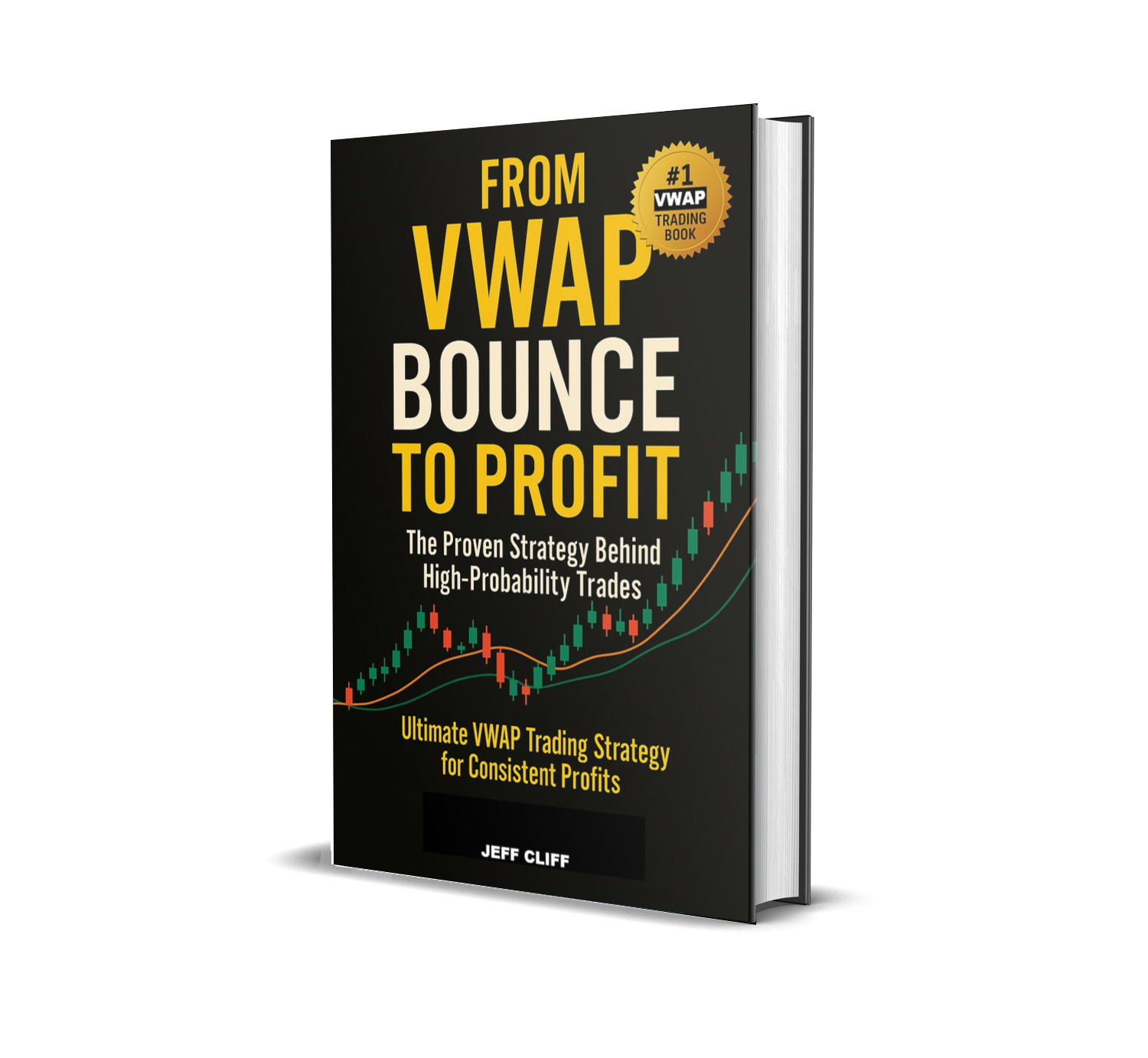
📘 From VWAP Bounce to Profit — The Full Playbook
In From VWAP Bounce to Profit, I share my complete VWAP system: scanners, A+ criteria, chart examples, risk templates, and journaling pages — so you can stop winging it and trade one proven setup with confidence.