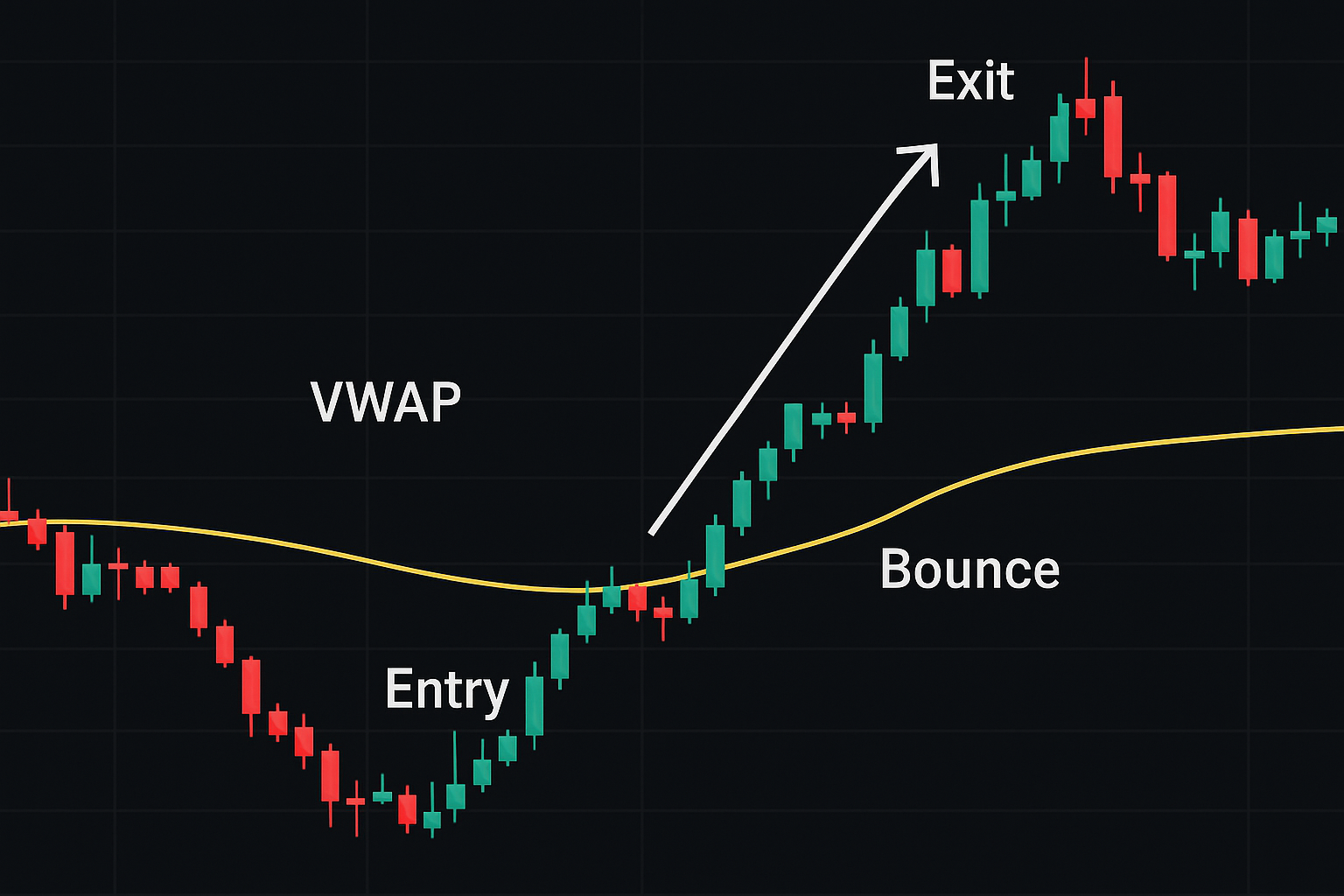
 Stock Reversal Strategy: How to Catch Explosive Trend Shifts
A Price Action & VWAP-Based Guide for Day Traders
One of the most powerful edges you can develop as a day trader is learning to spot reversals — the exact moments when a tired trend finally gives up and a new move begins in the opposite direction.
Instead of chasing breakouts and getting trapped at the high, the Stock Reversal Strategy helps you time entries where risk is tight, reward is large, and momentum is shifting in your favor. In this guide, we’ll break down a clean, rules-based reversal setup using VWAP, price action, and volume.
1. What Is a Stock Reversal?
A reversal happens when price stops trending in one direction, stalls, and then starts moving with conviction in the opposite direction. Unlike a small pullback inside a trend, a true reversal signals a shift in control between buyers and sellers.
Common causes of reversals include:
- Exhausted buyers or sellers after an extended trend.
- Strong support or resistance levels such as daily highs/lows.
- VWAP reclaims or rejections on intraday charts.
- Volume spikes showing climactic buying or selling.
- Trapped traders forced to cover or exit after a failed breakout or breakdown.
2. Why the Reversal Strategy Works So Well
Markets rarely move in straight lines. They move in impulsive waves and corrective pullbacks. When a move goes too far, too fast, it creates conditions where the trend is vulnerable to a sharp snapback.
The reversal strategy works because:
- It enters near the turning point, so stops can be tight.
- It captures moves where trapped traders are forced to exit in your direction.
- It combines context (trend) with location (VWAP/levels) and signal (candles & volume).
- It often aligns with VWAP reclaims, which many intraday traders and algos watch.
When done correctly, one good reversal trade can pay for a full week of small scratches and controlled losses.
3. The 6-Step Stock Reversal Strategy (Step-by-Step)
Let’s break the strategy into a simple, repeatable checklist you can use every day.
Step 1: Identify the Exhaustion Move
First, you want to see a move that looks extended and is starting to slow down. Signs of exhaustion:
- Multiple candles in the same direction with shrinking body size.
- Long wicks showing rejection at highs or lows.
- Volume spike followed by weaker follow-through.
- Breakout above a level that immediately stalls or fails.
Step 2: Mark Key Reversal Zones
A reversal is much more meaningful when it happens at a
- VWAP (for intraday reversals).
- Premarket high/low.
- Yesterday’s high/low.
- Major support or resistance on the 30-min or daily chart.
- Whole and half-dollar levels ($10, $10.50, $20, etc.).
When an exhaustion move slams into one of these levels and stalls, you have the location you need for a high-probability reversal setup.
Step 3: Wait for the Confirmation Candle
This is where most traders mess up—they jump in early and try to predict the turn. Instead, you want to wait for a candle that clearly signals rejection of the prior move, such as:
- Hammer (long lower wick, small body near the top).
- Shooting star (long upper wick, small body near the bottom).
- Engulfing candle (body fully engulfs prior candle).
- Inside bar → breakout (consolidation then break in the opposite direction).
Step 4: Enter on Break of Confirmation
Once you have a clear reversal candle at a key level, your entry is simple:
- Long entry: Enter when price breaks above the high of the reversal candle.
- Short entry: Enter when price breaks below the low of the reversal candle.
You want to see decisive movement as price breaks that level—not a weak, slow grind.
Step 5: Place a Tight Stop Loss
One of the biggest advantages of reversal trading is the ability to keep stops tight and controlled.
- For long reversals, place your stop below the low of the reversal candle.
- For short reversals, place your stop above the high of the reversal candle.
- Add a small buffer (e.g., $0.05–$0.10 on mid-priced stocks) to avoid random stop hunts.
This structure gives you clean “1R” risk that you can measure and repeat.
Step 6: Target Logical Profit Levels
Your targets will depend on where the reversal is happening and what the chart looks like.
- First target: nearest VWAP or intraday pivot.
- Second target: previous high/low of day.
- Third target: strong resistance or support from higher timeframe.
A common approach is to take partial profits at 1R and 2R, then trail a stop behind higher lows (for longs) or lower highs (for shorts) to let a big winner develop.
4. How VWAP and Volume Improve Reversal Accuracy
VWAP is one of the most powerful tools you can add to a reversal strategy because it shows where the average participant is positioned in terms of price.
VWAP-based reversal signals:
- Bearish reversal: Stock extended far above VWAP, stalls at resistance, then fails and reclaims back toward VWAP.
- Bullish reversal: Stock extended far below VWAP, prints climactic selling, then bounces and pushes back toward VWAP.
Volume confirms whether the reversal is driven by real commitment or just noise. Look for:
- Climactic volume on the exhaustion move.
- Strong volume on the reversal candle itself.
- Follow-through volume as price moves in the new direction.
5. Common Reversal Trading Mistakes to Avoid
Even a solid strategy can fail if you break your own rules. Watch out for these common errors:
- Entering too early before confirmation just because a move “feels extended.”
- Ignoring the higher timeframe trend and trying to fade strong daily momentum.
- Using wide stops that turn a small idea into a big problem.
- Revenge trading after a stop-out and jumping back in randomly.
- Trading low-volume names where price is easily manipulated.
Your job is not to catch every turn. Your job is to trade clean, high-quality reversals with defined risk and discipline.
6. Psychology: Why Reversal Trading Feels Hard (and How to Fix It)
Reversal trading is emotionally tough because you are stepping in against what just happened. Your brain sees green candles and thinks “it’s going higher,” or sees red and thinks “it’s going lower.”
To succeed, you must shift from reacting emotionally to reading the objective signals:
- Is the move extended?
- Is this a key level?
- Is there a clear reversal candle?
- Is volume supporting the shift?
- Is my stop and target clearly defined?
Final Thoughts: Add the Reversal Strategy to Your Playbook
A well-executed stock reversal strategy can transform the way you trade. Instead of chasing parabolic moves or panic-selling at the worst time, you start entering where risk is controlled and reward is meaningful.
Remember the core ingredients:
- Extended move (exhaustion).
- Key level (VWAP, support, resistance).
- Confirmation candle (hammer, shooting star, engulfing, inside break).
- Tight stop and logical targets.
Master this pattern, and you’ll stop feeling like the market is always one step ahead of you. Instead, you’ll feel like you’re finally trading with structure, timing, and confidence.
📘 From VWAP Bounce to Profit — Learn the Full Reversal & VWAP System
In From VWAP Bounce to Profit, I walk you through the complete VWAP-based trading system: reversals, bounces, continuation setups, and an opening-bell playbook you can follow every day. If you want a simple, repeatable process built around price action and VWAP, this book is your next move.