 VWAP Bounce Strategy: How to Use VWAP to Find Bounce Opportunities & Minimize Risk
A Step-by-Step VWAP Trading Playbook for Consistent Intraday Profits
VWAP isn’t just another line on your chart. For many institutions, it’s the benchmark price they use to measure execution quality. For intraday traders, that makes VWAP one of the most powerful tools for timing low-risk bounces, mean reversion trades, and trend continuation entries.
In this guide, you’ll learn a VWAP Bounce Strategy that shows you exactly how to use VWAP to identify bounce opportunities, minimize risk, and capture consistent profits—without overcomplicating your chart with a dozen indicators.
1. What Is VWAP and Why Do Traders Care?
VWAP stands for Volume Weighted Average Price. It’s calculated by taking the total dollar value traded (price × volume) and dividing it by the total volume over a specific session.
In simple terms, VWAP shows you the average price traders paid for a stock during the session, weighted by volume. That’s why it matters:
- Institutions: Use VWAP as a benchmark to see if they’re buying below or above the average price.
- Intraday traders: Use VWAP as a dynamic level for support, resistance, and mean reversion.
- Algorithms: Many execution algos are programmed around VWAP-based logic.
2. The Core Logic Behind the VWAP Bounce Strategy
The VWAP Bounce Strategy is built on one simple principle:
In a strong trend, pullbacks into VWAP often create low-risk entries in the direction of that trend.
In practice, that means:
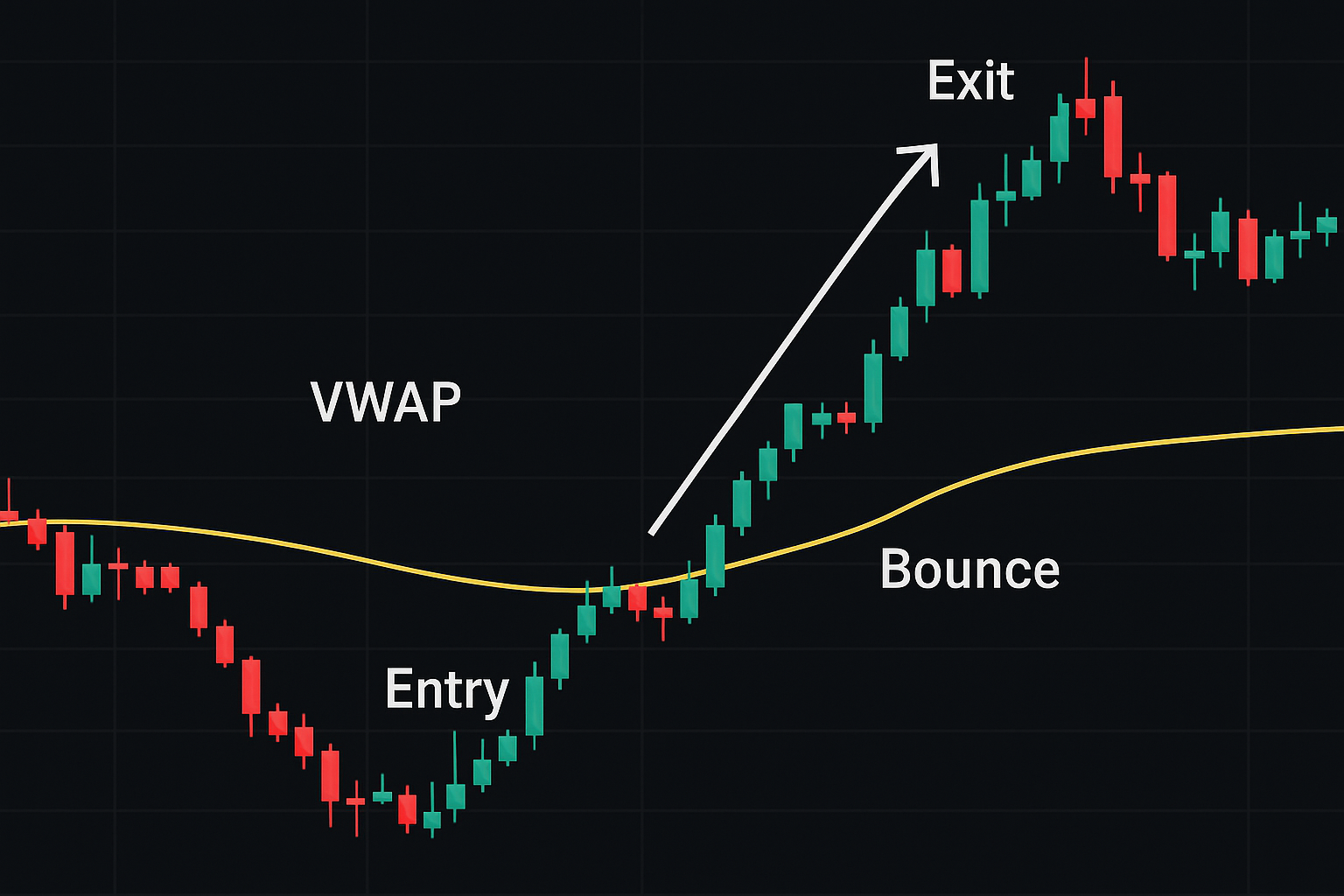
- In an uptrend, you look to buy pullbacks as price tests or slightly undercuts VWAP.
- In a downtrend, you look to short pops as price tests or slightly overthrows VWAP.
- You always combine VWAP with trend context, levels, and price action—never VWAP alone.
The result is a setup where:
- Your entry is near VWAP (a key institutional reference point).
- Your stop can be tight and logical (just beyond VWAP or the pattern low/high).
- Your target is a continuation move in the trend’s direction (HOD/LOD, range extremes, etc.).
3. The 6-Step VWAP Bounce Strategy (Bullish Version)
Let’s walk through a clean, bullish VWAP bounce you can apply on your intraday charts.
Step 1: Confirm the Uptrend
Before you think “bounce,” you need a trend. Look for:
- Higher highs and higher lows on the 1-min/5-min/15-min chart.
- Price trading above VWAP for a meaningful portion of the session.
- Clean breakouts that hold above prior resistance, not weak chop.
Step 2: Wait for Price to Pull Back Into VWAP
You’re not chasing the extension. You’re waiting for price to pull back toward VWAP after an impulsive leg up. Watch for:
- Orderly pullbacks with smaller red candles.
- No massive selling volume spike that suggests trend failure.
- Price approaching VWAP, ideally near prior intraday support or consolidation.
Step 3: Look for Confirmation at VWAP
At or near VWAP, you want to see buyers step back in. Confirmation can look like:
- Hammer candle with a long lower wick rejecting under VWAP.
- Engulfing green candle reclaiming VWAP after brief undercut.
- Small range basing right on VWAP followed by a strong breakout candle.
Combine this with a slight uptick in volume to confirm participation.
Step 4: Enter on Break of the Confirmation High
Once you have a confirmation candle, your entry trigger is simple:
- Go long when price breaks above the high of the confirmation candle.
- Avoid entering if price just drifts sideways without conviction.
Step 5: Place a Tight, Logical Stop
The VWAP bounce gives you a natural place for risk:
- Place your stop below VWAP and below the low of the confirmation candle.
- Add a small buffer to avoid noise (e.g., $0.05–$0.10 depending on the ticker’s volatility).
- Size your position so that this distance equals 1R of risk in your plan.
Step 6: Target Continuation Levels
Your first and second profit targets should align with clear intraday structure, such as:
- Previous high of day (HOD).
- Resistance from earlier in the session.
- Measured move based on the prior leg up.
Take partial profits at 1R and 2R, then trail a stop behind higher lows to see if you can ride a larger move.
4. Bearish VWAP Rejection: The Mirror Image Setup
The same logic applies in reverse for short setups. In a downtrend:
- Price trades below VWAP most of the session.
- Bounces into VWAP provide opportunities to short into strength.
- You look for upper-wick rejection candles and failed attempts to reclaim VWAP.
Entry and risk logic is just flipped:
- Enter short on break of confirmation candle low.
- Stop above VWAP and above the confirmation high.
- Targets at LOD, prior support, and measured move extensions.
5. Risk Management: How VWAP Helps You Trade Smaller but Smarter
One of the biggest advantages of the VWAP Bounce Strategy is how it naturally supports tight, defined risk.
A few risk rules to consider:
- 1 trade = 1R risk: Decide your dollar risk per trade (e.g., $50) and size your position based on the distance from entry to stop.
- 2–3 VWAP trades per day max: Avoid overtrading every tiny touch of VWAP.
- Stop trading VWAP when the tape gets sloppy: If price is ripping above and below VWAP repeatedly, step aside. VWAP has become a magnet, not a bounce zone.
6. Common VWAP Trading Mistakes to Avoid
Even a solid strategy breaks down if you misuse it. Watch out for these VWAP traps:
- Trading every VWAP touch: Not every touch is a trade. You still need trend, context, and confirmation.
- Ignoring the bigger picture: A VWAP bounce against a strong daily chart downtrend is much lower probability.
- Chasing extended moves away from VWAP: You want to buy pullbacks, not chase extensions.
- Holding through major news or halts: VWAP won’t save you if the stock gets hit by a surprise offering or disaster news.
- Oversizing because VWAP “feels safe”: It’s still just one tool—never a guarantee.
7. Building a Simple VWAP Playbook You Can Use Daily
To make VWAP trading systematic, turn this into a daily checklist:
- Pre-market: Mark key levels (premarket high/low, prior day high/low, key daily levels).
- At the open: Identify early trend direction relative to VWAP (is price holding above or below?).
- During the session: Wait for organized pullbacks into VWAP in the direction of the trend.
- At VWAP: Look for confirmation through price action (wicks, engulfing candles, breakouts) and supportive volume.
- Execute: Enter on break of confirmation, define stop, set 1–2 profit targets, and trail the rest.
- End of day: Screenshot your VWAP setups, log them in a journal, and track win rate and average R.
Final Thoughts: VWAP as the Backbone of Your Intraday Strategy
The VWAP Bounce Strategy gives you a clear, structured way to trade intraday trends without guessing tops, bottoms, or relying on lagging indicators. By focusing on VWAP, trend, and clean price action, you can build a repeatable playbook with defined risk and realistic profit targets.
You don’t need 20 strategies to be profitable. You need one or two solid setups that you can execute with discipline. VWAP bounces can easily be one of them.
Start small, track your trades, and refine your rules. Over time, VWAP will go from “just a line” to the backbone of your decision-making.
📘 From VWAP Bounce to Profit — The Complete VWAP System
In From VWAP Bounce to Profit, I walk you through the full VWAP playbook: opening drive trades, VWAP bounces, VWAP rejections, and advanced risk management—all in a simple, conversational style. If you’re serious about making VWAP your main edge, this book is your roadmap.